
More than 1,200 scholars, students, and guests from around the world gathered at Notre Dame for the de Nicola Center for Ethics and Culture’s 24th annual Fall Conference, “Ever Ancient, Ever New: On Catholic Imagination,” October 31–November 2, 2024. The conference featured more than 175 papers, panels, film screenings, and performances highlighting the enduring and inexhaustible nature of the Catholic imagination.
The de Nicola Center collaborated with the Biennial Catholic Imagination Conference on the theme for this year’s gathering. Established by Dana Gioia, an internationally acclaimed poet and author and the recipient of the 2010 Notre Dame Laetare Medal, the Biennial Catholic Imagination Conference enhances the understanding and appreciation of the richness and variety of contributions by Catholic artists; explores the critical and theoretical foundations of the Catholic imagination; and fosters community and collaboration among writers and readers who share a knowledge of and respect for the Catholic tradition.
This was the first Fall Conference led by de Nicola Center director Jennifer Newsome Martin, who took the reins of the center in July 2024, following the conclusion of O. Carter Snead’s twelve-year tenure as director. Under Snead’s leadership, the conference more than doubled in size and impact, and that growth continued in 2024 with nearly 150 more registrants than the previous record of 1,100 in 2023.
Gioia, former California state poet laureate, chairman of the National Endowment of the Arts from 2003 to 2009, and author of the landmark 2013 essay The Catholic Writer Today, opened the conference with a talk and reading titled “Becoming a Catholic Writer.” In his engaging presentation, he spoke about his upbringing in Los Angeles in a Catholic enclave surrounded by fellow Sicilian and Hispanic immigrant families, where each day began with Holy Mass at the local parish church. “By 9 in the morning, I had heard three languages—Italian, Spanish, and Latin: the languages of the old world, the new world, and the world to come.” He recounted his studies at Stanford and Harvard, where his desire to become a poet was awakened and nourished, leading to his subsequent development as a writer first as a hobby and now as his full-time vocation. He concluded his presentation by reciting seven of his poems and was lauded with a standing ovation by the overflow audience of more than 700 listeners.
Gioia spoke at other sessions during the conference, including a poetry reading and a standing-room-only jazz concert with Notre Dame composer and performer J.J. Wright. This year’s conference featured a number of musical performances throughout the weekend, including a piano performance of the works of Franz Liszt and discussion of his Catholic faith; a repertoire of sacred choral music performed by the Saint Hildegard Project in O’Shaughnessy’s Great Hall; and a raucous concert to close out the conference with Colin Cutler and Hot Pepper Jam, featuring their album inspired by the short stories of Flannery O’Connor.
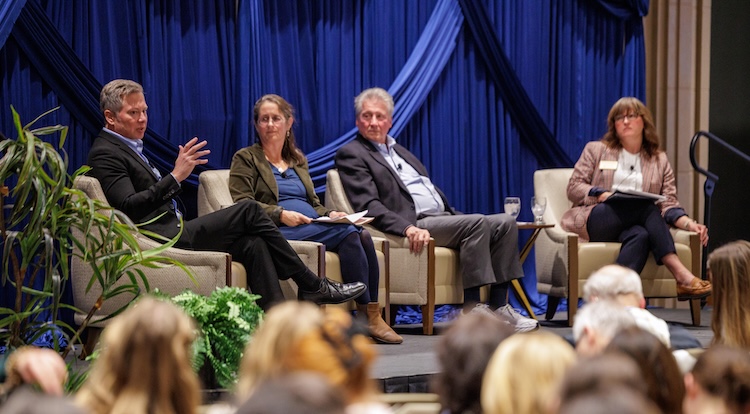
Judith Wolfe, professor of Philosophical Theology at the University of St. Andrews, Scotland, delivered the Friday evening plenary keynote of the conference, “The Theological Imagination,” reflecting on how Christian theology gives believers “the power to make the continuous stream of sense perception meaningful.” The conference concluded with a Saturday evening roundtable discussion of “The Future of the Catholic Imagination,” with author Ron Hansen and poets James Matthew Wilson and Sally Thomas, in conversation with dCEC director Jennifer Newsome Martin.
In his remarks at the closing roundtable, Wilson reflected on “the bold claim” asserted at the First Vatican Council that reason alone is not sufficient for human flourishing, but that the power of human imagination is a necessary adjunct to begin to comprehend God and His creation. Giving examples of how the Church has inspired great creative minds throughout its history, Wilson posited that forming the next generation of writers, filmmakers, poets, and musicians to carry on this work is an essential task of today’s practitioners of the arts. Evoking the closing lines of Alasdair MacIntyre’s After Virtue (Permanent Senior Distinguished Research Fellow at the de Nicola Center), Wilson concluded that “what we need is another, no doubt very different, Dante.”
More than 150 additional speakers and performers presented at the conference, including Cyril O’Regan, the Catherine F. Huisking Professor of Theology at Notre Dame and recipient of the 2024 Ratzinger Prize in Theology; Angela Alaimo O’Donnell, writer, poet, and professor, Fordham University; Irish poet and novelist John F. Deane; Robin Jensen, Patrick O'Brien Professor of Theology and Concurrent Professor of the History of Art at Notre Dame; and Academy Award–nominated animator and director Timothy Reckart.
Video recordings of many conference panels and performances will be available in the coming weeks at the de Nicola Center’s YouTube channel, youtube.com/ndethics.
At the conclusion of the closing roundtable, dCEC director Jennifer Newsome Martin announced that the 2025 Fall Conference will have the theme of “living tradition.” Dates, title, and the call for papers will be announced in early 2025.
Since 2000, the de Nicola Center’s annual Fall Conference has brought together the world’s leading Catholic thinkers, as well as those from other traditions, in fruitful discourse and exchange on the most pressing and vexed questions of ethics, culture, and public policy today. The Fall Conference has since become one of the most important academic fora for wide-ranging conversations that engage the Catholic moral and intellectual tradition from a variety of disciplinary points of departure, including theology, philosophy, political theory, law, history, economics, and the social sciences, as well as the natural sciences, literature, and the arts. Recent past speakers include Nobel Laureate James Heckman, Alasdair MacIntyre, John Finnis, Mary Ann Glendon, Rémi Brague, Charles Taylor, Michael Sandel, and Etsuro Sotoo.